Black pepper has shaped human history in ways that seem almost unbelievable. Among the many real episodes tied to this spice, one of the most striking is the true story of how black pepper helped trigger the age of exploration, reshaping trade, global navigation, and entire empires.
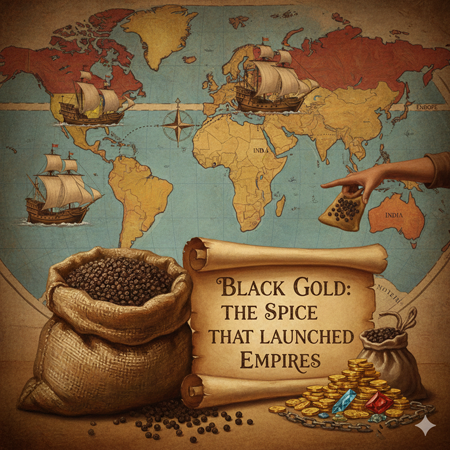
The pepper problem of the 1400s
By the late Middle Ages, black pepper was one of the most coveted plant-based commodities in Europe. It was entirely vegan—just a dried fruit—but its value was astronomical. In some cities, peppercorns were literally used as rent payments and collateral. They were stored in locked chests, guarded like treasure.
Yet Europe had a major problem: they couldn’t get pepper directly.
All pepper came from the Malabar Coast of India, and European merchants had to buy it through a chain of middlemen—Arab traders, Venetian shippers, and others along the route. Every time pepper changed hands, the price rose. By the 1400s, Venetians effectively held a monopoly over the spice in Europe.
This frustrated kingdoms like Portugal, who wanted direct access without paying Venice’s high markups.
A king obsessed with pepper
A very real historical figure, King Manuel I of Portugal, became especially fixated on breaking Venice’s stranglehold over the pepper trade. His treasury depended on it. Portuguese explorers had already inched down the African coastline, but no one had actually made it around Africa to India.
If they could reach India directly, pepper—and other spices—could be imported without intermediaries.
This goal was not about cuisine alone; pepper was used for medicine, preservation, perfumery, and even religious rituals. Control over pepper meant wealth and power.
The real voyage that changed everything (1497–1499)
In 1497, King Manuel sponsored a voyage that would permanently alter global history. He chose Vasco da Gama, a navigator from a noble but not wealthy family, to attempt a journey few believed possible: sail around the southern tip of Africa and reach India.
This wasn’t myth or embellishment—every stage of this expedition is documented in royal records and personal logs.
After an 11-month journey, braving scurvy, storms, desertion, and distrust in unfamiliar lands, da Gama reached Calicut (Kozhikode) on the west coast of India, the heart of the pepper trade.
Pepper was everywhere:
- drying on rooftops
- stacked in warehouses
- sold in open markets
- shipped by boatloads from nearby villages
Da Gama’s arrival marked the first time Europeans reached India by sea—a real, measurable turning point in world history driven largely by a desire for black pepper.
The return: a cargo worth more than its weight in gold
Da Gama left India carrying a modest amount of pepper and cinnamon (all vegan, all plant-based). But even this small shipment was extraordinary.
When he arrived back in Lisbon in 1499, his cargo generated a profit of over 60 times the expedition’s cost. This is not legend—these figures appear in Portuguese royal financial archives.
This moment proved that direct spice trade could transform a country. Portugal went from a minor kingdom to a global maritime power.
And it happened because of pepper.
Pepper’s ripple effects
The consequences of this real voyage are astounding:
1. The fall of Venice’s monopoly
Once Portugal had direct access to Indian pepper, Venice’s prices collapsed. Their centuries-long control evaporated almost overnight.
2. Portuguese colonies and trade networks
Portugal rapidly established forts and trading posts along the Indian Ocean, from Goa to Mozambique. This shaped politics, culture, religion, and migration in many regions—all originating from a pursuit of black pepper.
3. Global navigation techniques
The need for pepper-fueled exploration accelerated improvements in:
- ship design
- mapmaking
- celestial navigation
These advances fueled later global voyages by Spain, the Netherlands, and England.
4. Cultural exchange (and conflict)
Because pepper was transported by sea, new routes linked continents that had previously been largely isolated from each other. These connections—sometimes beneficial, sometimes destructive—reshaped the world permanently.
The most surprising fact of all
Despite its huge impact, black pepper is just a dried fruit from the vine Piper nigrum. Yet this entirely plant-based ingredient:
- drove empires to rise and fall
- motivated dangerous ocean voyages
- catalyzed scientific advancements
- altered global trade forever
This is all historically true, fully documented in maritime logs, royal decrees, and spice-trade archives.
A ingredient that redirected history
People today often think of pepper as ordinary, but historically, it was anything but. It was powerful enough to alter economies, inspire exploration, and redraw global maps.
And astonishingly, this vast historical change came from something as small and simple as a peppercorn.
